
How Online Hypnotherapy Works —
From Session One to Lasting Change
How it Feels
You are not asleep or unconscious; you are awake and aware, but deeply focused and less distracted by your surroundings.
It feels like deep relaxation and intense concentration, allowing you to experience thoughts and sensations differently.
What's happening in the brainThe prefrontal cortex, the brain's "gatekeeper," softens its filtering, allowing new ideas to reach the subconscious more easily.
It allows you to access and correctly sequence deep-seated patterns so they align with your “best self” interests.
Key takeaway
It's not about losing control; it's about gaining control by working with your subconscious mind, not against it, to create changes that align your conscious goals with your inner beliefs.

Process
I employ many different inductions. These are how I get you to the theta state. It’s the state of hyper-receptivity. I basically overload you with message units or environmental stimulus. The primitive area of your mind then escapes into trance via fight/flight response.
1. Induction
You achieve a heightened state of focused awareness, often with diminished peripheral awareness, making your subconscious more accessible.
2. Deepening
This is the core part, where the therapist provides guided suggestions, metaphors, or imagery to address your goals (e.g., quitting smoking, managing anxiety, changing perceptions).
3. Suggestions/Therapeutic Work
You are gently brought back to full waking awareness, often with post-hypnotic suggestions designed to continue working after the session.
4. Emerging

My Inductions
Confusion Inductions
These techniques overload the subject's conscious mind with illogical statements or complex tasks, leading to confusion. This state makes them more receptive to suggestions that help alleviate mental overload, such as the "7 plus or minus 2" method for analytical clients.
Pattern Interrupts
By interrupting a standard social pattern unexpectedly, like a handshake, this technique disrupts conscious processing, allowing the hypnotist to introduce an induction command during the break.
Elman Induction
This rapid induction method uses eye fixation followed by closure to quickly deepen the trance, utilizing tests like arm catalepsy to bypass critical thinking.
Fixation Inductions
Subjects focus on an external object, such as a swinging watch, causing eye fatigue and eyelid closure, which shifts their attention inward.
Active-Alert Inductions
These techniques induce hypnosis through physical activity, like leg movement, while maintaining focused attention, often resulting in sensations like warmth or automatic movements.
Conversational Hypnosis
This approach subtly weaves indirect suggestions into normal conversation, guiding the subject into a trance state without formal induction by utilizing language patterns and metaphors.
Movement-Based Inductions
Leveraging subconscious physical movements, such as arm levitation, this technique demonstrates the influence of the subconscious mind and helps deepen the hypnotic state.
Theory of the Mind
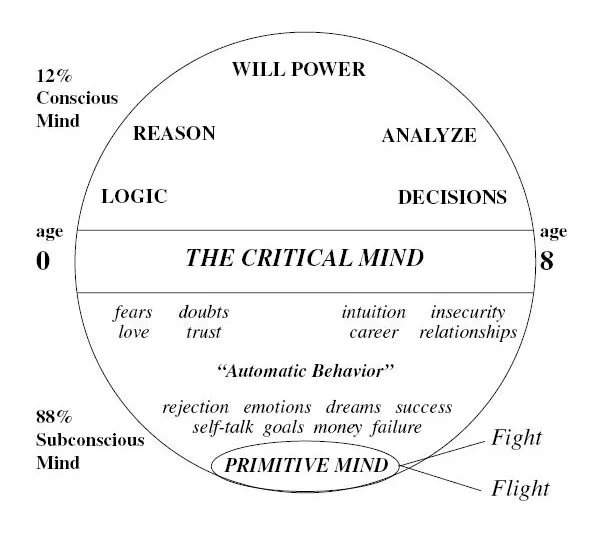
How Hypnosis and Suggestibility Works
The Theory of the Mind helps explain how our thoughts, habits, and emotional responses are formed. A small part of the mind—the conscious mind—is responsible for logic, analysis, and willpower. This is the part we use when making deliberate decisions or trying to “think our way” into change. Beneath that is the subconscious mind, which stores learned behaviors, emotional patterns, self-talk, beliefs, and automatic responses such as fear, confidence, motivation, or stress. Acting as a gatekeeper between the two is the critical mind, which develops early in life and filters new information based on past experiences. Hypnosis works by gently relaxing this critical filter, allowing positive suggestions to be received by the subconscious mind more easily. In this relaxed state, the mind becomes more open to forming healthier patterns—supporting lasting change in areas like habits, confidence, emotional regulation, and overall well-being.
Right brain suggestibility: The emotional and creative side listens literally but speaks inferred.
Left brain suggestibility: The logical and detail listens inferentially but sparks literally.
Contact
If you're ready to explore how hypnotherapy can help you overcome challenges, reduce stress, or achieve lasting change, contact me today — I'm here to listen, answer your questions, and design a session tailored to your needs. Whether you're curious about the process, want to discuss goals, or are ready to schedule an appointment, click the button below to learn more and take the first step toward transformation.